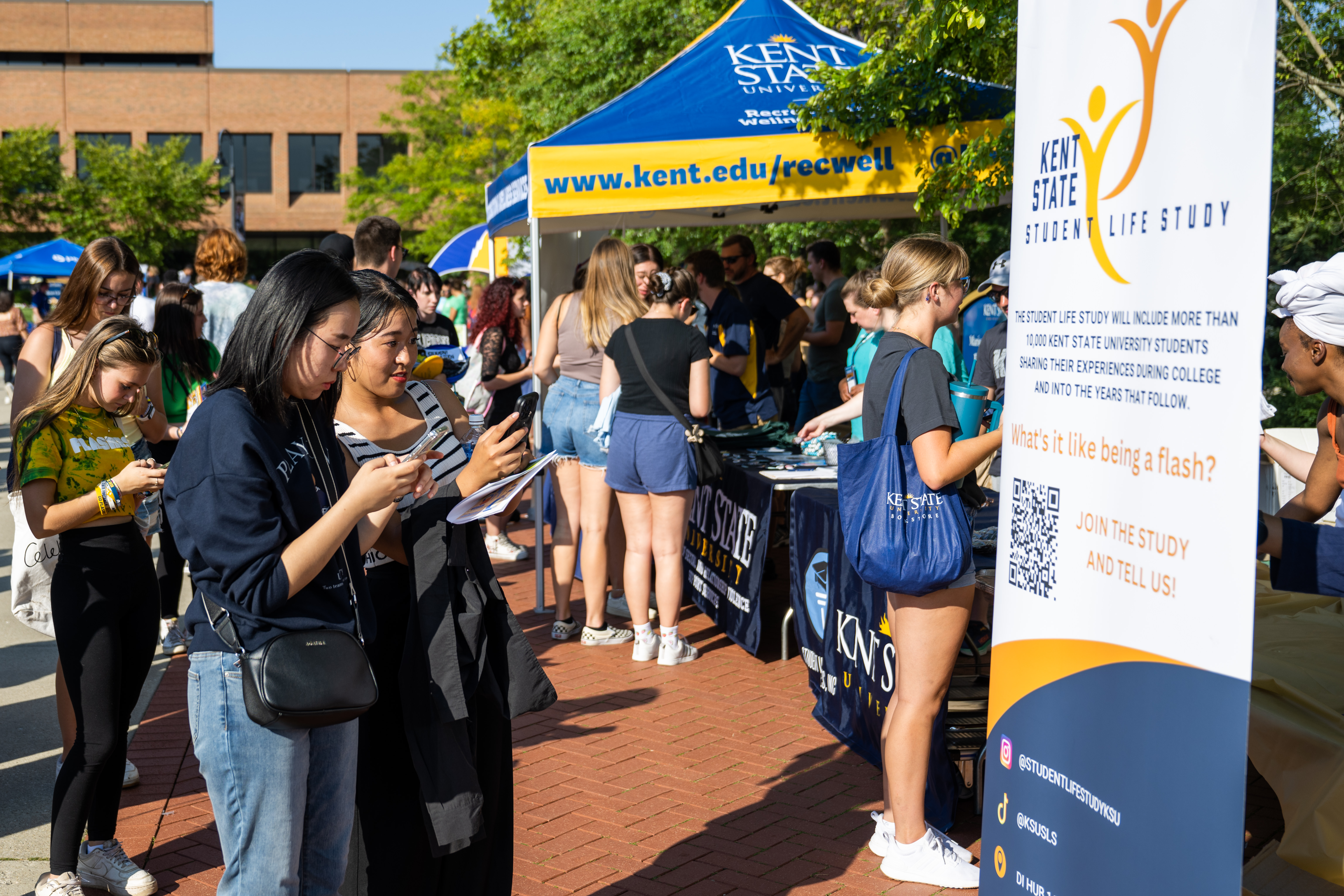
Nearly 10% of all Kent State University undergraduates are participating in the groundbreaking Kent State Student Life Study, providing the university with concrete information about what it’s like to be a modern-day college student.
Now in its third year, the study and its more than 3,000 participants have reached the place where they are providing information that can help influence university policy, said John Gunstad, Ph.D., professor of psychological sciences and a cofounder of the study with Karin Coifman, Ph.D., also a professor of psychological sciences and the newly appointed director of Kent State’s Brain Health Research Institute.
The pair shared updates with Kent State Today, noting how the main goal of the study has always been twofold: to provide useful information to the university to help students thrive, and to provide a platform for faculty and student researchers for scientific investigation of a critical period of transition into adulthood for lifelong health.
“A main goal for this project has always been to get a large enough number of students taking part in the study to allow the university to be nimble and agile,” Gunstad said. “So, if students identify something that isn’t working, we can provide feedback to the university.”
Eventually, the goal is to have 10,000 participants, but the directors are scaling up the pool of study participants in a purposeful way to ensure that its funding keeps up with its growth. Last year, the study received $510,000 in state grants for mental health research.

Lowering Stress and Anxiety
Some of the money was used toward a study of depression and anxiety in undergraduate students, which included a protocol for 1,600 participants using an intervention delivered via smartphone app for four minutes a day for 10 or 20 days.
“We found that depression decreased by 15% and anxiety dropped by 20% in students who took part,” Gunstad said. “This meaningful change in their everyday life took just four minutes per day over 10 days.”
Gunstad noted that four minutes is less time than it takes to microwave some foods, so the benefit was strong for the time commitment.
The intervention is called the Daily Coping Toolkit and was developed by Coifman and her team during the COVID-19 pandemic to help first responders and emergency medical personnel. The intervention needed to be quick, brief and effective to buffer stress, she said.
Student participants were asked to reflect on their day and then engage in activities to reduce the intensity of their emotions and boost their positive mood.
“This is a great tool that we have been developing for some time and appears to truly help our students manage stress more effectively,” Coifman said.
The intervention’s use also helped to identify key aspects of timing and dose so that the next time it is used, it can be even more useful to students, she said.
”The combination seems to have something magical about it that is providing an enormous benefit,” Gunstad said.
Embracing Analog
Now the research team is looking at how to optimize those interventions.
“We know that 60%-70% of Kent State undergraduates want to spend less time online, so we are looking into ways to offer effective analog interventions too,” Gunstad said.

Coifman said an important next step is to develop the ability to match psychological interventions to both student preferences and needs. This will include new work in the 2026 Fall Semester to broaden the format and the targets for interventions.
“If we can help students reduce stress, that's great. But what about getting them to feel more connected to others? That would also be very important,” she said.
Mining for Helpful Data
Study researchers are also analyzing student survey data to determine what campus resources, such as the Recreation and Wellness Center or available tutoring, are being used.
“The goal is to then provide information to the university of what types of resources and programs are most valuable for students,” Gunstad said.
“The university wants to know that resources are working for students, and the Student Life Study can help with that by matching usage to how students are experiencing the campus, their academic performance, and even overall health,” Coifman said.
The data from those surveys is being analyzed now and will be shared with the Division of Student Life within the next few weeks.
Growing Student Research
The study is also celebrating the achievement of having 60 student researchers active on the project.
Currently, both graduate and undergraduate students are working as part of the study team, representing a wide variety of majors outside of psychological sciences, including neuroscience, computer science, nursing and marketing.
Numerous undergraduate researchers from the project will be traveling to the annual conference of the Midwest Psychological Association in Chicago in April to present research they have conducted as part of the study, a point of pride for Gunstad and Coifman. Seven students presented their research at the conference last year and reported that the experience had a big impact on them and shaped their career goals.
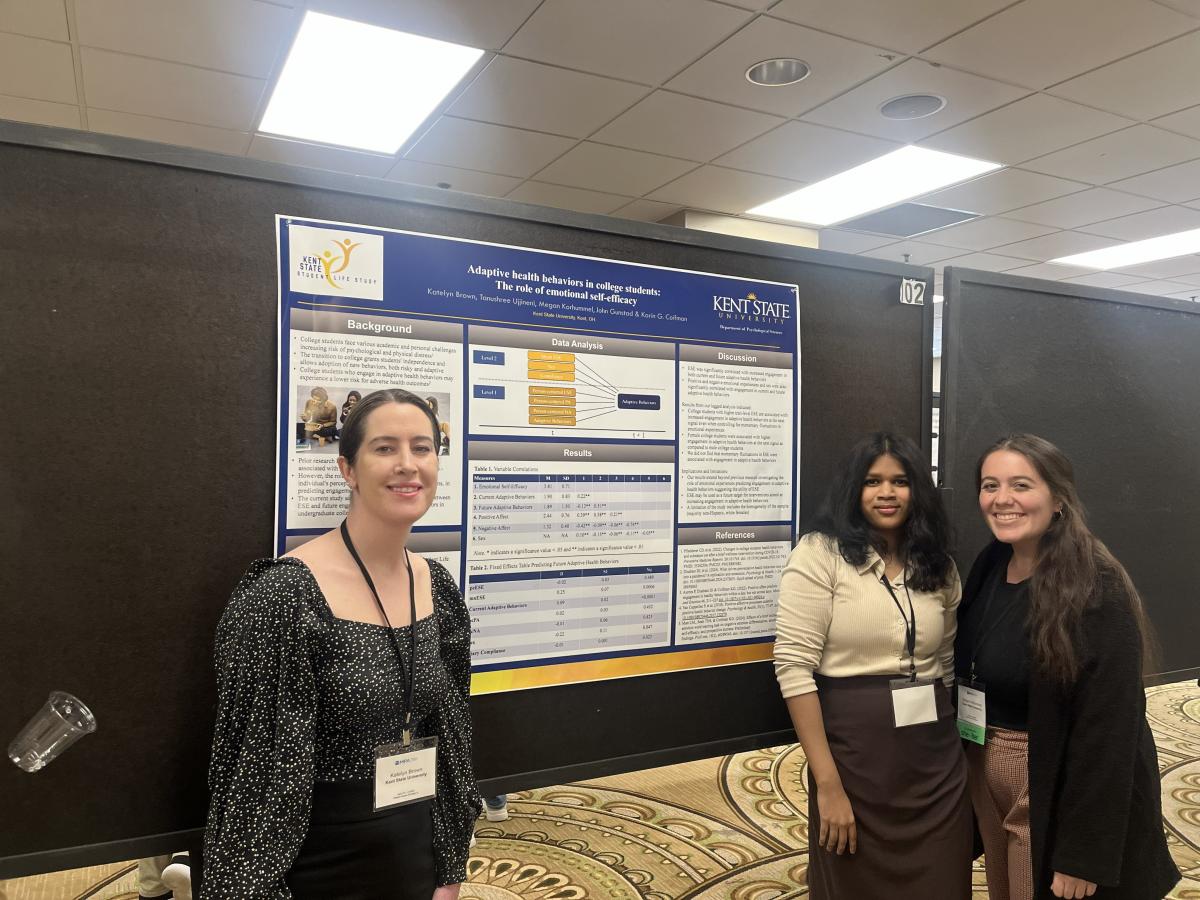
“This was transformational for these students,” said Coifman, who accompanied the students to Chicago. “They were able to present their work to other scientists in the field, meet and learn from others, and really get the feel for how important it is to disseminate this work.”
Researchers were also invited to present their work at the Learning Well Coalition meeting. This national organization promotes wellness and well-being in undergraduates and aims to improve the college experience.
“Their goal is for students to be able to have an educational experience that’s not just getting their degree and moving into the workforce,” Gunstad said. “But can you actually become better as an individual? Can you learn skills that are going to benefit you for a lifetime? Can you develop a love of learning and a passion to understand the world around you?”

Students presenting at this year’s conference and their research topics include:
- Amelia Pecic, senior psychology major from Macedonia, Ohio; Tanushree Ujjineni, senior neuroscience and psychology major from India; William Doering, sophomore psychology major from Rossford, Ohio; and Jillian Thomas, post-baccalaureate psychology major from Concord Township, Ohio, “When asked about stress, does the nervous system respond?”
- Allison Hlad, senior psychology major from Green, Ohio, “What Factors Impact Academic Success in First-Generation College Students?”
- Grace Meuleman, senior psychology major from Defiance, Ohio, “How do subjective cognitive complaints compare to objective measures of working memory?”
- Kayla Dixon, senior psychology major from Toledo, Ohio, “Feeling Ashamed? How do Self-Conscious Emotions Influence Behaviors?”
- Patrick Straits, senior psychology major from Walnut Creek, Ohio, “Is social support related to pain sensitivity?”
The Study Continues
The Student Life Study began in August 2023 and eventually hopes to sign up 10,000 participants. Researchers hope the study will generate data for decades to come that will help to improve the scientific understanding of health and well-being during this important developmental period, as well as inform decision-making to guide university administrators and policy makers in order to improve the lives of college students at Kent State and across the country.
The study operations are housed in 240 Kent Hall, and data collection laboratories are in rooms 205 and 231 of the Design Innovation Hub on the Kent Campus.
Learn more about the Student Life Study or register to participate.
Additional photos submitted by Karin Coifman, Ph.D.